


The One Time Jesus Got Angered
- Ed Malay
- Nov 10, 2025
- 4 min read

𝐍𝐎𝐕. 𝟗, 𝟐𝟎𝟐𝟓: 𝐃𝐄𝐃𝐈𝐂𝐀𝐓𝐈𝐎𝐍 𝐎𝐅 𝐒𝐓. 𝐉𝐎𝐇𝐍 𝐋𝐀𝐓𝐄𝐑𝐀𝐍 𝐁𝐀𝐒𝐈𝐋𝐈𝐂𝐀
𝐑𝐞𝐚𝐝𝐢𝐧𝐠 𝐈: 𝐄𝐳𝐞𝐤 𝟒𝟕:𝟏-𝟐, 𝟖-𝟗, 𝟏𝟐
𝐑𝐞𝐬𝐩𝐨𝐧𝐬𝐨𝐫𝐢𝐚𝐥 𝐏𝐬𝐚𝐥𝐦: 𝐏𝐬𝐚 𝟒𝟔:𝟐-𝟑, 𝟓-𝟔, 𝟖-𝟗 “𝐓𝐡𝐞 𝐰𝐚𝐭𝐞𝐫𝐬 𝐨𝐟 𝐭𝐡𝐞 𝐫𝐢𝐯𝐞𝐫 𝐠𝐥𝐚𝐝𝐝𝐞𝐧 𝐭𝐡𝐞 𝐜𝐢𝐭𝐲 𝐨𝐟 𝐆𝐨𝐝, 𝐭𝐡𝐞 𝐡𝐨𝐥𝐲 𝐝𝐰𝐞𝐥𝐥𝐢𝐧𝐠 𝐨𝐟 𝐭𝐡𝐞 𝐌𝐨𝐬𝐭 𝐇𝐢𝐠𝐡.”
𝐑𝐞𝐚𝐝𝐢𝐧𝐠 𝐈𝐈: 𝟏 𝐂𝐨𝐫 𝟑:𝟗-𝟏𝟏, 𝟏𝟔-𝟏𝟕
𝐆𝐎𝐒𝐏𝐄𝐋: 𝐉𝐍 𝟐:𝟏𝟑-𝟐𝟐
𝑲𝒆𝒚 𝑽𝒆𝒓𝒔𝒆: “𝑫𝒆𝒔𝒕𝒓𝒐𝒚 𝒕𝒉𝒊𝒔 𝒕𝒆𝒎𝒑𝒍𝒆 𝒂𝒏𝒅 𝑰 𝒘𝒊𝒍𝒍 𝒓𝒂𝒊𝒔𝒆 𝒊𝒕 𝒂𝒈𝒂𝒊𝒏 𝒊𝒏 𝒕𝒉𝒓𝒆𝒆 𝒅𝒂𝒚𝒔.” (𝒗.19)
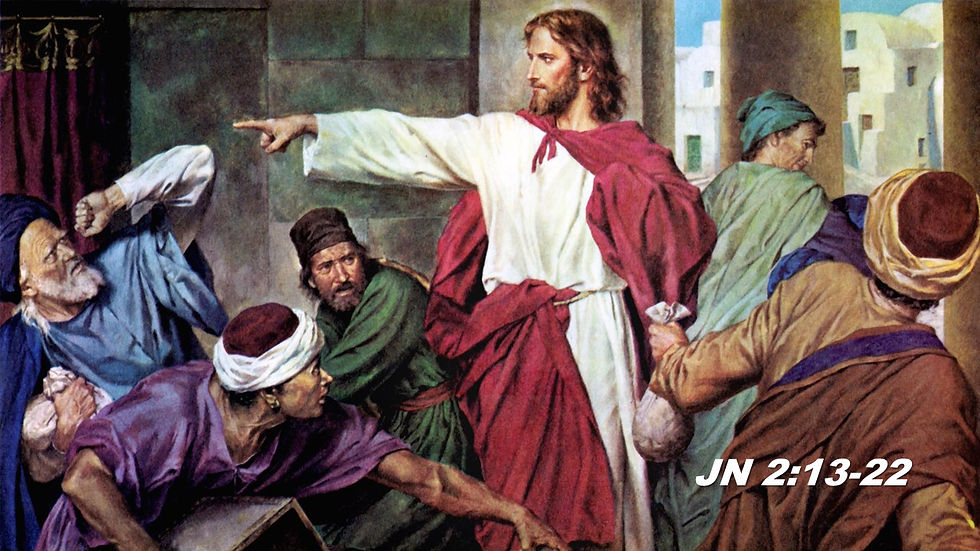
In what could be the only instance when Jesus really showed his anger was when he arrived at the temple and saw that it has been turned into a marketplace (𝐯.𝟏𝟒) or as what Jesus described as a den of robbers (𝐌𝐤 𝟏𝟏:𝟏𝟕)..
The illustration of Jesus holding a whip made out of cords must have been a terrifying scene as he drove away the sheep and cattle and overturned the tables of money changers thereby scattering all the coins and monies.
All these happened during the Passover which was and still is considered as the most memorable feasts of the Jewish nation and by law and tradition, all adult male Jew are bound to go to the temple to celebrate the feast of the Passover.
The Temple was always crowded during the Passover Feast (𝐄𝐱𝐨 𝟏𝟐) which normally lasts a day while the Festival of the Unleavened Bread (𝐋𝐞𝐯 𝟐𝟑:𝟔) lasts for the rest of the week. These two festivals are celebrated by the Jews starting on the 14th day of the first month which is the Passover Feast while the Festival of the Unleavened Bread starts on the 15th day of the same month.
The religious leaders, however, allowed money changers and merchants to set up trading booths at the Temple that made it difficult for the people to worship which was the main purpose of the Jews for visiting the Temple. What the religious leaders forgot was that God’s Temple was a place of worship and not for profit. And this apparent desecration was what made Jesus angry.
And the religious leaders asked for a sign as proof of his authority and Jesus replied by saying “𝒅𝒆𝒔𝒕𝒓𝒐𝒚 𝒕𝒉𝒊𝒔 𝒕𝒆𝒎𝒑𝒍𝒆 𝒂𝒏𝒅 𝑰 𝒘𝒊𝒍𝒍 𝒓𝒂𝒊𝒔𝒆 𝒊𝒕 𝒂𝒈𝒂𝒊𝒏 𝒊𝒏 𝒕𝒉𝒓𝒆𝒆 𝒅𝒂𝒚𝒔.” (𝒗.19) And they failed to grasp the meaning of what he said because they were on different planes with Jesus talking of his coming passion, death and resurrection while the religious leaders could only see what was before them which was why they asked for a sign.
What Jesus was referring to was it was his own body which was the Temple that needed to be destroyed through his passion and death and raised again on the third day. What Jesus was also saying in this passage was that there would be no need any more for sacrificial offering because he himself will be the sacrifice at the altar on which a new Temple will rise.
But while we may have done away with animal sacrifice in today’s world, we may have replaced this unknowingly with paraphernalia that we try to pass on as part of our worship to God as we build beautiful edifices, innovated our liturgical and worship celebrations, designed programs and projects that we believe edify Our God but which in reality are taking away our attention to what worship should be.
What then is the relevance of this passage to the practice of our faith in the here and now? Contrary to what the Pharisees believe, we must acknowledge that Jesus was the Temple that had to be destroyed so that through his death on the cross he can bridge the gap between God and man by offering himself as a ransom for many.
It is through his death that reconciles us with God, and he fills us with his Holy Spirit that makes us now the new temples (𝟏 𝐂𝐨𝐫 𝟔:𝟏𝟗-𝟐𝟎). Where the Temple was supposed to be the place of worship of the Jews in the olden times, Jesus has changed all that as we can now worship God anywhere we are or in whatever situation we find ourselves in because Jesus who is the personification of the Temple of God is now present in all of us who believe.
It presupposes that whoever lives in a state of grace is a living temple which means that our souls must live in the closest possible union with God. Every temple has a priest, an altar and a tabernacle. These elements are also present in a Christian who is in a state of grace because the Christian disciple himself is the priest and we are called upon to fulfill our priestly ministry by turning our whole life into a spiritual Mass.
The altar is our hearts united with God and on it we sacrifice and lay upon everything that separates us from God – our anxiety, irritations, bitterness, resentments, unforgiveness, failure and frustrations, etc. And finally, the tabernacle is our own soul where our Trinitarian God dwells.
It is when we see ourselves as the Temple of God that we can now see God not only in us but in others as well. This paradigm shift in our attitude towards worship will allow us to give due respect and reverence to our neighbor and it is also this realization of our true worth that we can perform good works accompanied by prayer and fasting, alms-giving and regular reception of the Sacraments and attendance in Prayer Meetings.
And it is when we put into motion this grace that moves us to love God and our neighbor that our lives are sanctified. As 𝐒𝐭. 𝐉𝐨𝐡𝐧 𝐂𝐡𝐫𝐲𝐬𝐨𝐬𝐭𝐨𝐦 says: “𝐇𝐞 𝐰𝐡𝐨 𝐞𝐧𝐭𝐞𝐫𝐬 𝐢𝐧𝐭𝐨 𝐚 𝐬𝐭𝐚𝐭𝐞 𝐨𝐟 𝐆𝐫𝐚𝐜𝐞 𝐢𝐬 𝐥𝐢𝐤𝐞 𝐚 𝐦𝐚𝐧 𝐛𝐨𝐰𝐞𝐝 𝐝𝐨𝐰𝐧 𝐰𝐢𝐭𝐡 𝐢𝐧𝐟𝐢𝐫𝐦𝐢𝐭𝐢𝐞𝐬 𝐚𝐧𝐝 𝐚𝐠𝐞 𝐰𝐡𝐨, 𝐛𝐲 𝐚 𝐦𝐢𝐫𝐚𝐜𝐥𝐞, 𝐡𝐚𝐬 𝐛𝐞𝐞𝐧 𝐭𝐫𝐚𝐧𝐬𝐟𝐨𝐫𝐦𝐞𝐝 𝐢𝐧𝐭𝐨 𝐚 𝐛𝐞𝐚𝐮𝐭𝐢𝐟𝐮𝐥 𝐲𝐨𝐮𝐭𝐡 𝐝𝐫𝐞𝐬𝐬𝐞𝐝 𝐢𝐧 𝐩𝐮𝐫𝐩𝐥𝐞 𝐚𝐧𝐝 𝐜𝐚𝐫𝐫𝐲𝐢𝐧𝐠 𝐚 𝐬𝐜𝐞𝐩𝐭𝐞𝐫.” (𝘌𝘥 𝘔𝘢𝘭𝘢𝘺 - 𝘕𝘰𝘷. 9, 2025)


Comments