


Gratitude Is Grace In Action
- Ed Malay
- Oct 12, 2025
- 5 min read

𝐎𝐂𝐓. 𝟏𝟐, 𝟐𝟎𝟐𝟓: 𝐓𝐖𝐄𝐍𝐓𝐘 𝐄𝐈𝐆𝐇𝐓𝐇 𝐒𝐔𝐍𝐃𝐀𝐘 𝐈𝐍 𝐎𝐑𝐃𝐈𝐍𝐀𝐑𝐘 𝐓𝐈𝐌𝐄
𝐑𝐞𝐚𝐝𝐢𝐧𝐠 𝟏: 𝟐 𝐊𝐠𝐬 𝟓:𝟏𝟒-𝟏𝟕
𝐑𝐞𝐬𝐩𝐨𝐧𝐬𝐨𝐫𝐢𝐚𝐥 𝐏𝐬𝐚𝐥𝐦: 𝐏𝐬𝐚 𝟗𝟖:𝟏-𝟒 “𝐓𝐡𝐞 𝐋𝐨𝐫𝐝 𝐡𝐚𝐬 𝐫𝐞𝐯𝐞𝐚𝐥𝐞𝐝 𝐭𝐨 𝐭𝐡𝐞 𝐧𝐚𝐭𝐢𝐨𝐧𝐬 𝐡𝐢𝐬 𝐬𝐚𝐯𝐢𝐧𝐠 𝐩𝐨𝐰𝐞𝐫.”
𝐑𝐞𝐚𝐝𝐢𝐧𝐠 𝟐: 𝟐 𝐓𝐢𝐦 𝟐:𝟖-𝟏𝟑
𝐆𝐎𝐒𝐏𝐄𝐋: 𝐋𝐤 𝟏𝟕:𝟏𝟏-𝟏𝟗
𝑲𝒆𝒚 𝑽𝒆𝒓𝒔𝒆: “𝒚𝒐𝒖𝒓 𝒇𝒂𝒊𝒕𝒉 𝒉𝒂𝒔 𝒎𝒂𝒅𝒆 𝒚𝒐𝒖 𝒘𝒆𝒍𝒍.” (𝒗.19)
What we have today is a moving story that should remind us of our attitude towards God. It teaches us to be always grateful for the blessings we have received especially those that God has poured out on us even if we didn’t ask for it.
God sent his only begotten Son so that whomsoever believe in him will not perish but will have eternal life (𝐉𝐧 𝟑:𝟏𝟔). God need not send his Son but he did, and Jesus had to suffer and die on the cross for us – to ransom us from our sinfulness but more so out of his great love for us.
We all know the story. We have heard it many times. Jn 3:16 after all is what is largely known as everybody’s text, and we have practically heard countless homilies, sermons and reflections on this but the question is – have we expressed our gratitude to God for all he’s done for us. Do we wake up in the morning and say, “Good morning, Lord, thank you for this brand new day you’ve given me.” Many of us don’t even offer grace before meals anymore.
Such ingratitude to God probably has its roots in the environment we grew up with which is the reason why many of us became adults without realizing there is so much to thank God for in our lives. In fact, even the lives we now have are on account of God’s generosity and we should always consider it a blessing that we still woke up knowing God has given us another day.
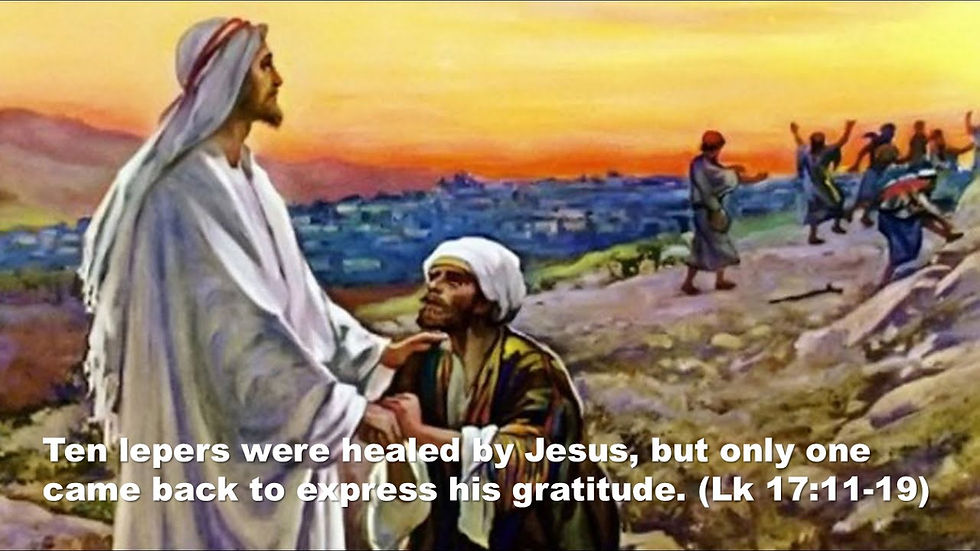
Going back to the Gospel passage today, we most certainly will be moved to ask about the nine of the ten lepers in this story. We see Jesus who was practically amazed at the ingratitude of the nine lepers as he asked: “𝑩𝒖𝒕 𝒕𝒉𝒆 𝒐𝒕𝒉𝒆𝒓 𝒏𝒊𝒏𝒆, 𝒘𝒉𝒆𝒓𝒆 𝒂𝒓𝒆 𝒕𝒉𝒆𝒚?” (𝒗.17). And so, to distinguish the one leper who returned Jesus continued asking: “𝑾𝒂𝒔 𝒏𝒐 𝒐𝒏𝒆 𝒇𝒐𝒖𝒏𝒅 𝒕𝒐 𝒓𝒆𝒕𝒖𝒓𝒏 𝒂𝒏𝒅 𝒈𝒊𝒗𝒆 𝒑𝒓𝒂𝒊𝒔𝒆 𝒕𝒐 𝑮𝒐𝒅 𝒆𝒙𝒄𝒆𝒑𝒕 𝒕𝒉𝒊𝒔 𝒇𝒐𝒓𝒆𝒊𝒈𝒏𝒆𝒓?” (𝒗.18).
To get right inside this Gospel passage which does not appear in any of the other gospels, we see Jesus moving on the road between Galilee and Samaria and he was met by ten lepers who stayed at a distance – about 50 yards away – because lepers are considered unclean and are prohibited by Jewish law to get near a clean or healthy person.
We also see in this story that in time of great need even those who are separated by racial prejudice forget that they were Jews and Samaritan and what they only know was that they were in need. In fact, even in this post-modern era one of the factors that draw people together is their common need for God.
What comes as a surprise was that the ten lepers did not ask for healing but what they did ask was “pity” as they cried out from a distance: “𝑱𝒆𝒔𝒖𝒔, 𝑴𝒂𝒔𝒕𝒆𝒓, 𝒉𝒂𝒗𝒆 𝒑𝒊𝒕𝒚 𝒐𝒏 𝒖𝒔.” (𝒗.13) And moved with pity and compassion and without telling them they were healed, Jesus told them to show themselves to the priest (𝐯.𝟏𝟒). And you might ask why? It’s because the priests are the one who are to declare them clean and free of leprosy. As they went, they were cleansed.
It is at this point that the drama begins because of the ten lepers only one returned to thank Jesus who called the leper a foreigner (𝐯.𝟏𝟖) because he was a Samaritan and that meant that he and Jesus were divided by tradition and cultural differences.
Jesus knew he would again incur the ire of the Pharisees because it was unlawful in those days for a Jew to associate with a Samaritan but Jesus effectively tore down the barrier separating the two tribes when he gave credence to the public confession of gratitude by the Samaritan and rewarding him when he said: “𝑹𝒊𝒔𝒆 𝒂𝒏𝒅 𝒈𝒐, 𝒚𝒐𝒖𝒓 𝒇𝒂𝒊𝒕𝒉 𝒉𝒂𝒔 𝒎𝒂𝒅𝒆 𝒚𝒐𝒖 𝒘𝒆𝒍𝒍.” (𝒗.19)
The question now is, do we find anything significant in this passage? Aren’t we being reminded of the times when we failed to express our gratitude to those who have helped us get over our needs in the past? Are we like those who never came back when we got what we wanted?
How about our relationship with our parents? In our growing up years we were totally dependent on our parents for almost everything we need yet there are instances when aging parents have become a nuisance in the lives of many people.
Don’t we also have a debt to pay to friends who may have sympathized with us when we were at the low point of our lives? Perhaps to our teacher who unselfishly imparted his wisdom to us that ensured our future. Or maybe even a priest who has offered us valuable counsel in times we may have reached a dead end.
Aren’t we also ungrateful to God whom we remember and pray to with great intensity during the stormy days in our lives and whom we tend to forget when the dark clouds passed us by. God gave us his only Son, and we’ve never even said thank you Lord.
Today, God is reminding us to do what the Samaritan did. He came back and prostrated himself at the feet of Jesus and thanked him. For all the bountiful blessings we have received, God expects us to be grateful and one of the ways we can thank God for what he’s done is for us to start looking for those whom God has richly blessed but who have not even dared look back much less return.
In these times when our relationship with God is tested by the corruption around us which has affected our faith, we have a duty to go back to God and rekindle our faith. In the words of 𝐏𝐨𝐩𝐞 𝐁𝐞𝐧𝐞𝐝𝐢𝐜𝐭 𝐗𝐕𝐈: “𝘐𝘵 𝘸𝘢𝘴 𝘶𝘳𝘨𝘦𝘯𝘵 𝘵𝘰 𝘮𝘢𝘬𝘦 𝘊𝘩𝘳𝘪𝘴𝘵 𝘬𝘯𝘰𝘸𝘯 𝘢𝘨𝘢𝘪𝘯 “𝘸𝘩𝘦𝘳𝘦 𝘵𝘩𝘦 𝘧𝘪𝘳𝘦 𝘰𝘧 𝘎𝘰𝘥” 𝘩𝘢𝘴 𝘣𝘦𝘤𝘰𝘮𝘦 𝘮𝘦𝘳𝘦 “𝘦𝘮𝘣𝘦𝘳𝘴 𝘵𝘩𝘢𝘵 𝘯𝘦𝘦𝘥 𝘵𝘰 𝘣𝘦 𝘳𝘦𝘬𝘪𝘯𝘥𝘭𝘦𝘥 𝘴𝘰 𝘪𝘵 𝘤𝘢𝘯 𝘢𝘨𝘢𝘪𝘯 𝘣𝘦 𝘢 𝘭𝘪𝘷𝘦𝘭𝘺 𝘧𝘭𝘢𝘮𝘦 𝘵𝘩𝘢𝘵 𝘨𝘪𝘷𝘦𝘴 𝘭𝘪𝘨𝘩𝘵 𝘢𝘯𝘥 𝘸𝘢𝘳𝘮𝘵𝘩 𝘵𝘰 𝘵𝘩𝘦 𝘦𝘯𝘵𝘪𝘳𝘦 𝘩𝘰𝘶𝘴𝘦.”
Following the Synodal Assembly, the Church is also telling us that our duty to evangelize is premised on presenting once more the beauty and perennial newness of the encounter with Christ to the often distracted and confused heart and mind of the men and women of our time, above all to ourselves.
We must also remember that the call for us to bring Christ to others is inclusive the aim of which is to bring back everyone into the church especially the baptized Catholic Christians but who for some reason are not practicing their faith.
To do this we all must go out and evangelize because it is the duty of everyone who believes that Jesus Christ came, died and rose again from the dead to save us from eternal damnation to bring the Gospel of Christ to the ends of the world. To evangelize is to teach and this is the call to everyone who has ears and not just to a select few.
And in today’s Gospel passage, the Church invites us all to contemplate the face of the Lord Jesus Christ, to enter into the mystery of his existence that was given for us on the cross, reconfirmed in his resurrection from the dead as the Father's gift and imparted to us through the Spirit. In the person of Jesus, the mystery of God the Father's love for the entire human family is revealed.
So, we are enjoined to be grateful for what God has done for us and we are obliged to return to the source of all Grace and give him thanks. (𝘌𝘥 𝘔𝘢𝘭𝘢𝘺 – 𝘖𝘤𝘵. 12, 2025)


Comments